Lady Petra Investigates #4
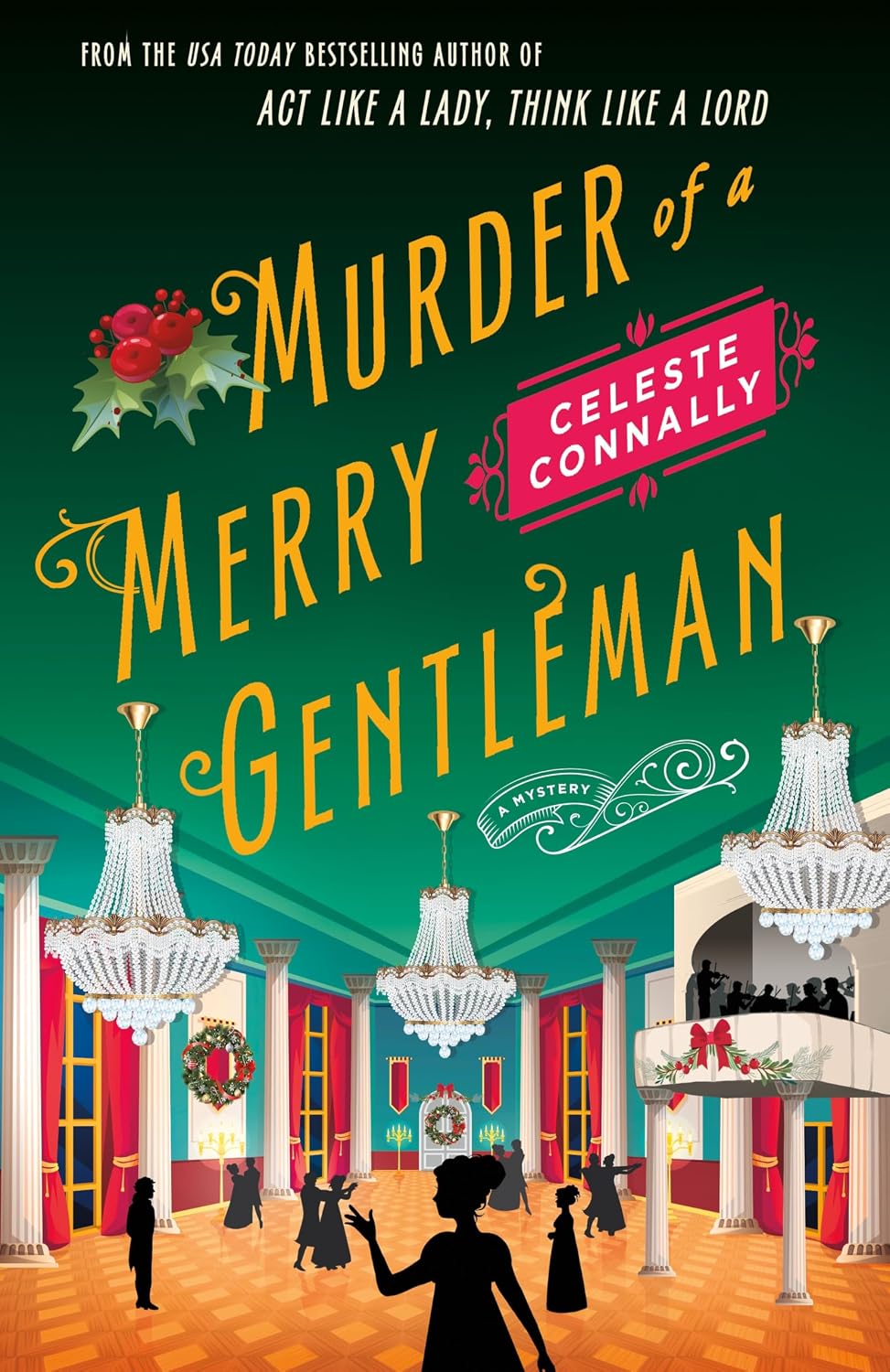 Murder of a Merry Gentleman is the fourth book in Celeste Connally’s Lady Petra Investigates series of Regency mysteries, featuring Lady Petra Forsyth, an intrepid, unconventional noblewoman who is an expert horsewoman, carries a dagger and a set of lockpicks, and uses her brilliant mind to solve crimes. After the suspicious death of her fiancé in the first book in the series, Petra has sworn never to marry, but her vow has been put to the test by the handsome Duncan Shawcross. For the time being, she has defied social convention by sleeping with Duncan outside of wedlock, and not bothering to hide the relationship, but it is clear Duncan wants to marry her, and it seems her resistance may be slowly breaking down, but I will not say any more about how the relationship develops. I will say that Duncan is largely absent from this book, away on a secret mission for the government, so Petra is left to her own devices in solving the murder.
The book takes place during the Christmas season of 1815. The patronesses of Almack’s Assembly Rooms, including Petra’s childhood friend Iris, decide to host a series of charity auction balls in which the families of unmarried young women bid on their daughters’ right to be the star of the ball. The young lady whose family places the highest bid will be known as the Christmas Rose for that evening’s ball, and will have her choice among four eligible bachelors, all young scientists returned from the Grand Tour. The bachelors are not obliged to marry the young ladies, but each prefers one of the potential Christmas Roses. In honor of the Christmas season, the bachelors are known as the Merry Gentlemen. One is Lord Ashwell, Iris’ brother, a childhood friend of Petra. He seems to have been romantically attracted to Petra at one time, but she always thought of him as a friend, and now they are more like brother and sister than romantic partners.
Four of the women whose families are bidding on the dances are also scientists, members of a club called the Minerva Society, dedicated to furthering women in scientific research. Each of the four Minervas, as they’re called, is working in a different branch of science and has a counterpart among the Merry Gentlemen. At least two of the Minervas are attracted to their counterparts, but they also accuse the Merry Gentlemen of disparaging women in the sciences, and of stealing their work and claiming it as their own.
At the first ball, one of the Merry Gentlemen, Heathcliff Dearden, is found dead after falling from the musicians’ balcony. (At first, I thought the name Heathcliff was invented by Emily Brontë, and so would be anachronistic in a book that takes place in the Regency, but later I found that it is much older than that, even though Emily Brontë certainly popularized it.) His body is surrounded by the Minervas when Petra arrives on the scene. She sees a wound on Dearden’s temple that does not seem to come from a fall and finds an eyepiece from a microscope that fits the wound and is obviously the murder weapon. The four Minervas immediately become suspects, but Iris and the other patronesses want to cover up the death so that the charity balls can go on, and they pretend Dearden has been called away from London. Privately, though, Iris asks Petra to investigate and to go undercover as a potential Christmas Rose, with her father bidding on dances for her with the three remaining Merry Gentlemen.
Another plotline involves Teddy, a street urchin who helped Petra on previous cases, and whom she has come to love almost as a son. Teddy arrives at Petra’s house in tears, saying his mother has been falsely convicted of theft and is in Newgate Prison, awaiting transport to Australia. He says Petra must visit his mother and talk to her, to try to prove her innocence and get her released. When Petra goes to visit her in Newgate, though, the guard tells her that Teddy’s mother refuses to see her and gives her only a cryptic message, telling her to talk to a certain Madame Conklin, who turns out to be the madam of a brothel. Madame Conklin is a colorful character who once worked in the theater, and she provides Petra with a disguise to help her in her investigation. I will not say what the disguise is, though. It’s better to read the book and find out.
I will not give away any more of the plot, but I will say that the two plotlines, the investigation into Heathcliff Dearden’s murder and whether or not the Merry Gentlemen stole the Minervas’ research, and the quest to save Teddy’s mother from being sent to Australia, come together in an unexpected way. I will also say that I never guessed who the murderer was until close to the end, and the book has a very suspenseful and exciting conclusion.
I highly recommend Murder of a Merry Gentleman, which certainly stands on its own, even though, if you want to know more about Petra’s background, it is best to start at the beginning of the series. Petra is a wonderful heroine, brave and intelligent, who knows the rules of society but has decided to defy them. This book includes fascinating details about Regency Christmas celebrations, at least among the aristocracy and upper classes, and I would recommend it to anyone who enjoys a good Christmas mystery.
Also, I would especially recommend this book to fans of other authors of Regency mysteries, such as Darcie Wilde and, most of all, Andrea Penrose. In fact, this book has much in common with Penrose’s series, including street urchins who become almost like sons to the heroine, and explorations of Regency science. In Connally’s series, though, it is only this book that deals with science, at least so far. In Penrose’s, it’s the whole series. Also, I think Connally’s series has a lighter tone than Penrose’s. What I really loved about this book was what Connally has to say about women in the sciences. The Minervas are fictional, but there were women who worked in the sciences during the Regency and were largely uncredited. The story of women’s research being stolen or looked down upon by male colleagues, sadly, continues. I don’t know where Petra’s next adventure will take her, but I hope she encounters the women of the Minerva Society again. — Vicki Kondelik