Lady Emily #20
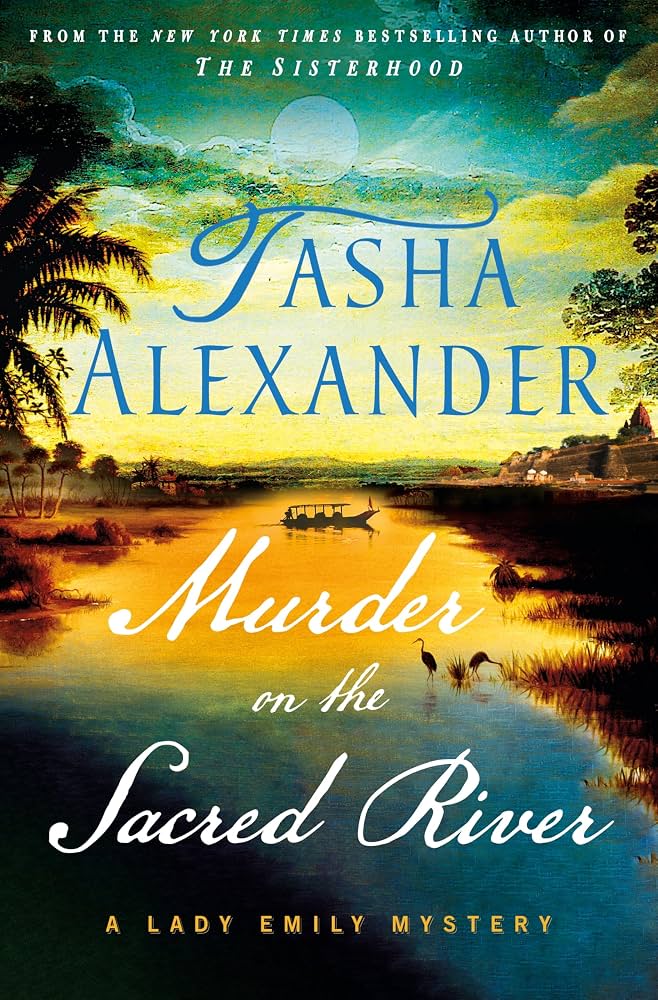 Murder on the Sacred River is the twentieth novel in Tasha Alexander’s series about Lady Emily Hargreaves, an unconventional English noblewoman in the late 19th-early 20th century, and her handsome husband Colin, a secret agent for the British government. Long-time readers of the series will know that Emily and Colin have traveled all over the world, and that each book—at least, the ones that don’t take place in England—has a different setting. This one takes place in India in 1908. The beginning of the book finds Emily and Colin staying with a group of British tourists at the Ahilya Fort in Maheshwar. This fort was built in the 18th century by the maharani Ahilya (full name: Ahilyabai Holkar), a ruling queen who was, and still is, revered for improving the lot of the common people of her kingdom, especially women. As usual with Alexander, Emily’s adventures are intertwined with a plot set in the more distant past, and in this book it’s the story of Ahilya, and how she came to rule her kingdom.
Emily and Colin’s stay at the fort is disturbed by the discovery of the body of an Englishman found shot to death in a boat on the sacred Narmada River. One of their fellow tourists, Ralston, identifies the body as that of a friend of his. Ralston didn’t know that the man was in India, and no one else in the group knew him, so it’s hard to find a motive. This group includes quite an assortment of characters. Besides Ralston, there is a historian, Desmond Montgomery, who is doing research on Ahilya. Also in the group is Imogen, a pleasant, unmarried woman in her late 20s, who, in those days, is considered a spinster, and her companion, the very unpleasant Miss Whitcombe, who is rude to everyone. Emily doesn’t know how Imogen can stand traveling with Miss Whitcombe, but Imogen explains that her companion had a tragic childhood. Dr. Varma, an Indian physician, takes Emily around the city and acts as a translator for her. Emily, who is usually wonderful at languages, has a hard time with Hindi. Emily soon meets Mrs. Ghosh, a widow who is having an affair with Montgomery and who helps her in the murder investigation.
The local police are out of their depth with the murder and leave it to Colin, with the help of Emily, of course, to investigate. Emily and Colin find a witness, Mr. Lanka, a seller of chai, who saw a man and a woman moving along by the river at the time of the murder, even though, of the whole group, only Miss Whitcombe heard the gunshot. Veer, an eight-year-old orphan boy, saw similar comings and goings. Then Lanka is also murdered, and the police are even more unwilling to investigate the death of an Indian than that of an Englishman. A theme that runs throughout the book is the arrogant attitude of the British toward the Indians, an attitude not shared by Emily and Colin, but which is shared by several members of the group. Emily is appalled by the way the English act as though theirs is the superior culture, even though, as she points out, England is a young country compared to India.
The case takes a shocking turn when a new traveler arrives at the fort. To say more would be a huge spoiler, but I will say that this new twist changes everything about what we thought we knew about the case, and, instead of no one having a motive, it turns out that everyone has one. This is a truly brilliant twist to the plot. The roots of the case seem to go back to a love triangle in the past, and the tragic death of a young woman in Africa. Several characters who supposedly had no desire to go to India are, of course, there now, and some have better reasons for being there than others.
Emily and Colin have known since the beginning that the dead man was not shot in the boat, but was killed elsewhere, and his body was moved into the boat. Colin finds the actual site of the murder, and he discovers coins with Ahilya’s face on them and a pair of earrings which might have belonged to Ahilya. Emily wonders if this was part of a larger treasure, and if the treasure was the real motive for the murder. Mrs. Ghosh denies this, though, and says Ahilya didn’t wear jewelry, at least during her widowhood, and before her widowhood, Ahilya didn’t live in Maheshwar, but in her capital of Indore.
The case takes a series of unexpected turns, even after the big twist, and I will not spoil it by saying whether the love triangle or Ahilya’s treasure has anything to do with the murder, or even whether the treasure exists. I will say, though, that I never guessed who the killer was. I thought it was someone entirely different. I love the way Emily and Colin each come to a solution by different ways. Emily usually relies on intuition, and Colin on hard facts, but both methods lead to the same conclusion. Unfortunately, Emily’s and Colin’s twin sons Henry and Richard have stayed behind in England, so we don’t get their contributions to the case, even though there is a delightful thread where Henry, the livelier and more mischievous of the two, wants his parents to bring him an elephant from India.
The parallel plot, about Ahilya and how she came to be a great ruler, is just as compelling as the main plot. In fact, as much as I love Emily and Colin, when one of Ahilya’s chapters ended, I always felt like I couldn’t wait to get back to her story. This part of the book begins in 1740, when Ahilya is fifteen and has been married to the maharaja’s heir for seven years, ever since both were children. Her in-laws think very highly of her and see qualities in her that would make a strong ruler—qualities that are missing from their son. Ahilya’s husband, Khanderao, spends his time drinking and sleeping with his concubines, and shows no interest in her, or in ruling the kingdom. But Ahilya knows it is time for her to consummate her marriage and produce an heir.
It is heartbreaking to read about Ahilya’s attempts to do everything she can to make her husband love her, only to have him ignore her. She always thinks she will be able to improve him, and she knows he could be a better man, if only he listened to her and stayed away from alcohol, opium, and other women. Khanderao is a brave soldier, and Ahilya accompanies him into battle and becomes an expert on artillery. Another important part of the story is Ahilya’s friendship with Kiya, a woman of the people, who, although of a much lower social status than Ahilya, understands her and her marriage in a way that Ahilya herself does not.
Parts of Ahilya’s story are very tragic and have to do with the Hindu ritual of sati (more commonly spelled suttee), in which a widow commits suicide on her husband’s funeral pyre. I don’t think it is a spoiler to say that Ahilya contemplates sati but decides not to do it (and gets criticized by some, for that reason). After all, we know, from Emily’s story, that Ahilya spent many productive years as a widow and ended up ruling the kingdom in her own right after the death of her father-in-law. During her reign, Ahilya was a patron of the arts and did much to improve the lot of the common people, especially women. She founded educational institutions for women, and a weaving workshop for women who could not otherwise make a living.
This is a wonderful novel, and while I was reading, I did not know whether Ahilya was real or fictional. Unfortunately, the advance copy of the ebook that I read did not include an author’s note, so I looked online and was delighted to find she was real. The Wikipedia page for Ahilyabai Holkar (her full name) would indicate that Alexander follows her story very well. Also, Alexander’s website includes beautiful pictures of Ahilya’s fort and other nearby sites where the novel takes place.
I also made a less than delightful discovery on Alexander’s website. The page for Murder on the Sacred River says that it is the last book in the series. I hope that is just a misprint, and that what’s really meant is that it’s the latest, not the last. I love this series, and as far as I know, it’s been very popular, so I would be surprised if the publisher dropped it. Of course, publishers have dropped other series I thought were very popular (Susan Elia MacNeal’s Maggie Hope, for example). This book didn’t feel like a series ending, and it left a few threads hanging. I would especially love to find out what happens with Henry and the elephant. So, I hope this is just a mistake on the website.
If this is the last book, or even if it is not, but you would like some further reading, I have some recommendations. This book, with its setting in India, will appeal to fans of Sujata Massey, Harini Nagendra, and Nev March. There are many series with Victorian sleuthing couples I would recommend, especially Elizabeth Peters’ Amelia Peabody series, which was an inspiration for this one. In fact, I first “met” Tasha Alexander online in an old Yahoo group for fans of Amelia Peabody, and I remember when she announced her first book there. More recently, there are Dianne Freeman’s Countess of Harleigh mysteries and Andrea Penrose’s Earl and Countess of Wrexford mysteries (a Regency couple, but the dynamic between the two leads, and their contrasting ways of approaching a case, reminds me of Emily and Colin). Also, there are the Jane Wunderly mysteries by Erica Ruth Neubauer, which take place later, in the 1920s, but which include many of the same elements: an unconventional young widow (as Emily is when you first meet her), an enigmatic secret agent who becomes her second husband, and each book featuring a different setting. Even with all these different series, though, Alexander’s is outstanding, and I hope it is not coming to an end anytime soon. — Vicki Kondelik