Rosalind Thorne/Useful Woman #9
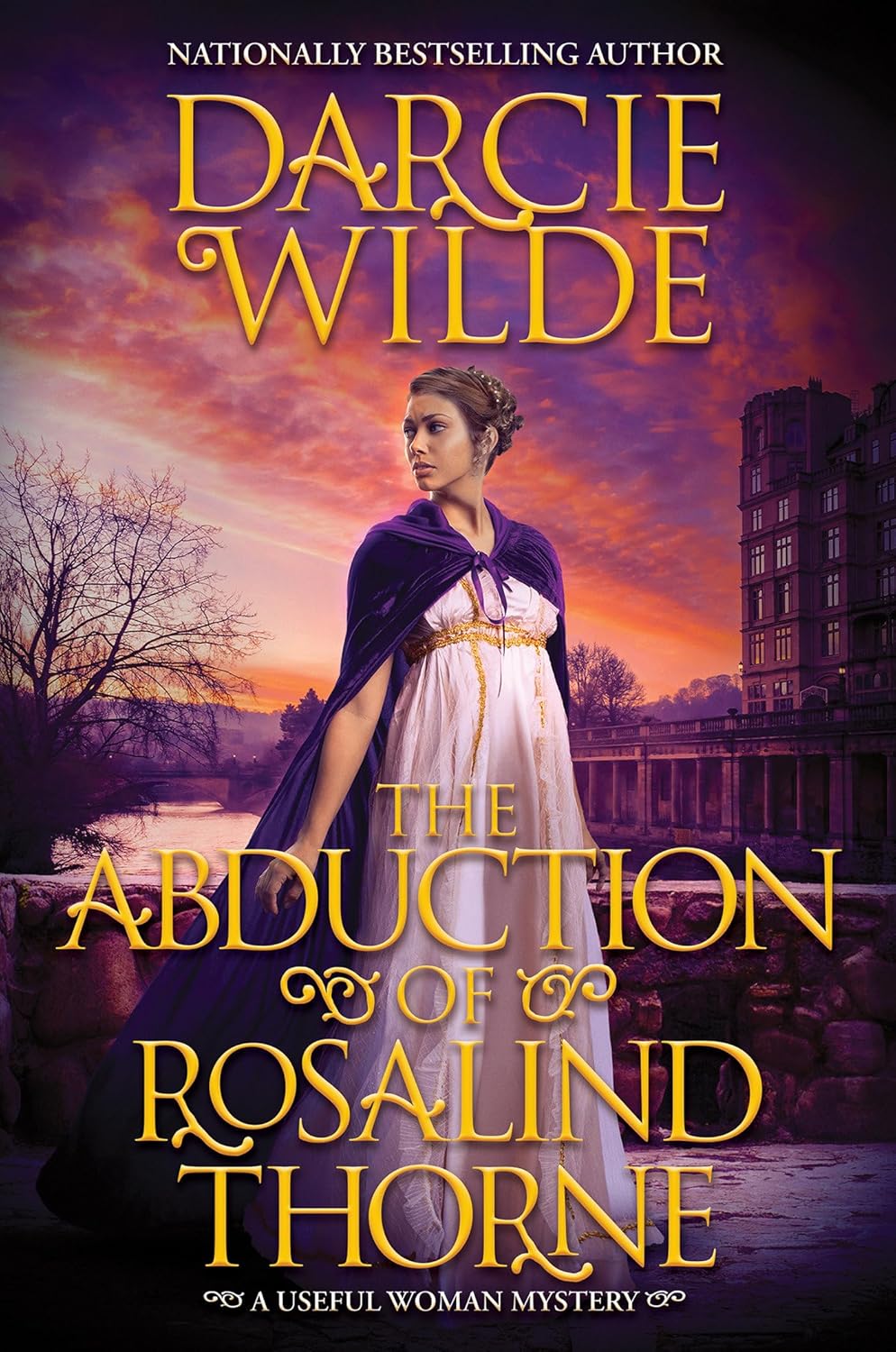 The Abduction of Rosalind Thorne is the ninth volume in Darcie Wilde’s Rosalind Thorne/Useful Woman series of Regency mysteries, and I am very glad that the publisher finally recognizes that it’s all the same series. For a while, they were calling the last few volumes the Useful Woman Mysteries and renumbering them, starting from Book 1. Rosalind is a gentlewoman who has fallen on hard times after her father, who was deeply in debt, abandoned his family. She discovers she has a talent for solving people’s problems, and she makes a living by offering her assistance to gentlewomen and aristocrats in difficulty. Her cases often involve blackmail, scandal, and murder.
People who have read the series from the beginning will know that Rosalind has had a complex love life. Her first love, before her family’s disgrace, was Devon Winterbourne, the younger son of the Duke of Casselmaine. At the same time as Rosalind’s family scandal happened, Devon unexpectedly inherited the dukedom. He still loved Rosalind despite her family situation, but she began to develop feelings for Adam Harkness, a Bow Street Runner, a member of London’s Regency police force. This love triangle played out through the first several volumes, until Rosalind rejected Devon’s marriage proposal. In the volume before this one, Rosalind got engaged to Adam. Now Adam is no longer with Bow Street because he was too honest for his commanding officer, who would let criminals go when it pleased those in power. Instead, he assists Sir David Royce, the coroner of London.
As this book begins, Devon has gotten engaged, in his turn, to Clara Kinsdale, a baronet’s daughter. He and Clara come to Rosalind’s house to ask for assistance. Even though Rosalind no longer loves Devon and is happily engaged to Adam, she still feels apprehensive about meeting Devon’s new fiancée. She takes a liking to Clara, though, and agrees to help. Clara’s father, Sir Anthony Kinsdale, is in debt and has moved to Bath with Clara and her two sisters, and he has let his country house to Admiral Walsingham. A widow, Mrs. Lynn, has attached herself to Sir Anthony. She is the particular friend of the oldest daughter, Elizabeth, but Clara and her younger sister, Cynthia, distrust her and think she’s a fortune hunter who only showed interest in the family after Clara got engaged to a duke. Clara wants Rosalind to discover what Mrs. Lynn’s motives are, and to separate her from the family if she is up to no good.
No sooner does Rosalind agree to go to Bath to help Clara than another visitor arrives at her house: a young woman calling herself Miss Smith, although Rosalind doubts that’s her real name, who claims to be Mrs. Lynn’s illegitimate daughter. She says her mother has done nothing worse than bearing a child out of wedlock, and Rosalind should not try to separate her from Sir Anthony. Rosalind doesn’t trust Miss Smith, who claims to be a schoolgirl but looks much older. While she and Adam go to Bath, Rosalind’s assistant, Alice Littlefield, a gossip columnist turned novelist, stays behind in London to investigate Miss Smith.
In Bath, Rosalind and Adam pose as a married couple, to explain the fact that they’re traveling together, and meet Sir Anthony and his other two daughters, Elizabeth and Cynthia, as well as Mrs. Lynn. Sir Anthony appears to have nothing but contempt for his youngest daughter, Cynthia, while Elizabeth seems to be the favorite. Rosalind and Adam are invited to what is described as a small card party at Sir Anthony’s house, but this proves to be anything but. Mrs. Lynn is practically running a casino, with people gambling for high stakes, and moneylenders present to lend people the money they can’t afford to spend—at high interest rates, of course. Rosalind also discovers that Sir Anthony has entered a horse in an upcoming race. This horse is in bad shape and is certain to lose. Mrs. Lynn and her fellow conspirators are planning to substitute a lookalike horse that is a likely winner, and to make a fortune when their horse wins. Meanwhile, Alice finds that Miss Smith frequents the gambling houses of London, and she is in on the horse racing scheme as well.
Sir Anthony’s behavior at the party is erratic, to say the least. He banishes Cynthia to her bedroom, and then his tenant, Admiral Walsingham, comes to confront him. Sir Anthony has evicted him on flimsy grounds. Not long after their quarrel, Sir Anthony is found dead, in an apparent fall from a window. The coroner of Bath arrives at the house. He is a man of not much imagination, who takes everything at face value, and he is quick to decide that Sir Anthony’s death was no more than it appears—an accident. But Adam finds contradictory evidence and is sure that Sir Anthony was murdered. Shortly afterwards, Admiral Walshingham is shot to death. Adam believes the two deaths are connected, and even though the coroner doesn’t think so, he agrees to postpone the inquest until Adam can find witnesses to testify.
Elizabeth swears that she saw Mrs. Lynn quarreling with Sir Anthony shortly before his death, so Mrs. Lynn becomes the prime suspect and is arrested. Rosalind doesn’t believe Elizabeth’s testimony, though, and wonders why Elizabeth would betray her friend. She and Adam are determined to find the real killer before Mrs. Lynn is executed for a crime she didn’t commit. The case takes many twists and turns that are too complex, and contain too many spoilers, to describe here, but Rosalind and Adam face great danger. Will they escape with their lives?
This is a very suspenseful book, and the plot has so many threads that I wondered how Wilde was going to tie it all together. She does, though, in a satisfactory way. I love Rosalind’s character. She is intelligent and resourceful and figures out how to get herself and Adam out of dangerous situations. Rosalind and Adam are a great couple, who love and respect each other as they solve crimes together. My one complaint, and it is a small one, is that I think the title is somewhat misleading. The abduction referred to in the title doesn’t happen until about ¾ of the way through the book. I think it’s supposed to take you by surprise when it happens, but, because of the title, the reader comes to expect it. You are kept in suspense about how Rosalind is going to escape, though.
Wilde begins each chapter with a quotation from Jane Austen’s Persuasion. She has always said the series was inspired by Austen. A previous volume included quotations from Pride and Prejudice, and there were parallels in the plot. This book definitely has parallels with Persuasion, and, by pure coincidence, I happened to be rereading Persuasion, a few chapters at a time, at the same time I was reading The Abduction of Rosalind Thorne. Anyone familiar with Persuasion will recognize the parallels: the baronet, a vain man obsessed with appearances, with three daughters, who has fallen into debt and is forced to move to Bath and let his country estate to an admiral, and the fact that the oldest daughter is named Elizabeth and is her father’s favorite. Persuasion also has its scheming widow, Mrs. Clay, who has attached herself to the father and is a close friend of the oldest daughter. Mrs. Lynn is even more of a schemer than Mrs. Clay, but the reader is never sure of her motives, and part of the fun is trying to figure them out. Wilde takes situations familiar from Austen and uses them in new ways. This is a loving tribute to Persuasion. “Miss Smith,” of course, also recalls Harriet Smith from Austen’s Emma.
This is a wonderful series, and I was very glad to see it continue, because the previous volume, where Rosalind gets engaged to Adam at the end, felt like a wrap-up and because Wilde started a new series—excellent so far—about the young Queen Victoria. Without giving too much away, this book feels like a wrap-up, too, but I hope I’m wrong, as I was with the previous one. If the series continues, as I hope it does, I would love to see what lies ahead for Rosalind and Adam. I highly recommend these books to fans of Anna Lee Huber, Andrea Penrose, and Celeste Connally, and to Austen fans who also love mysteries. — Vicki Kondelik