An American in Paris #4
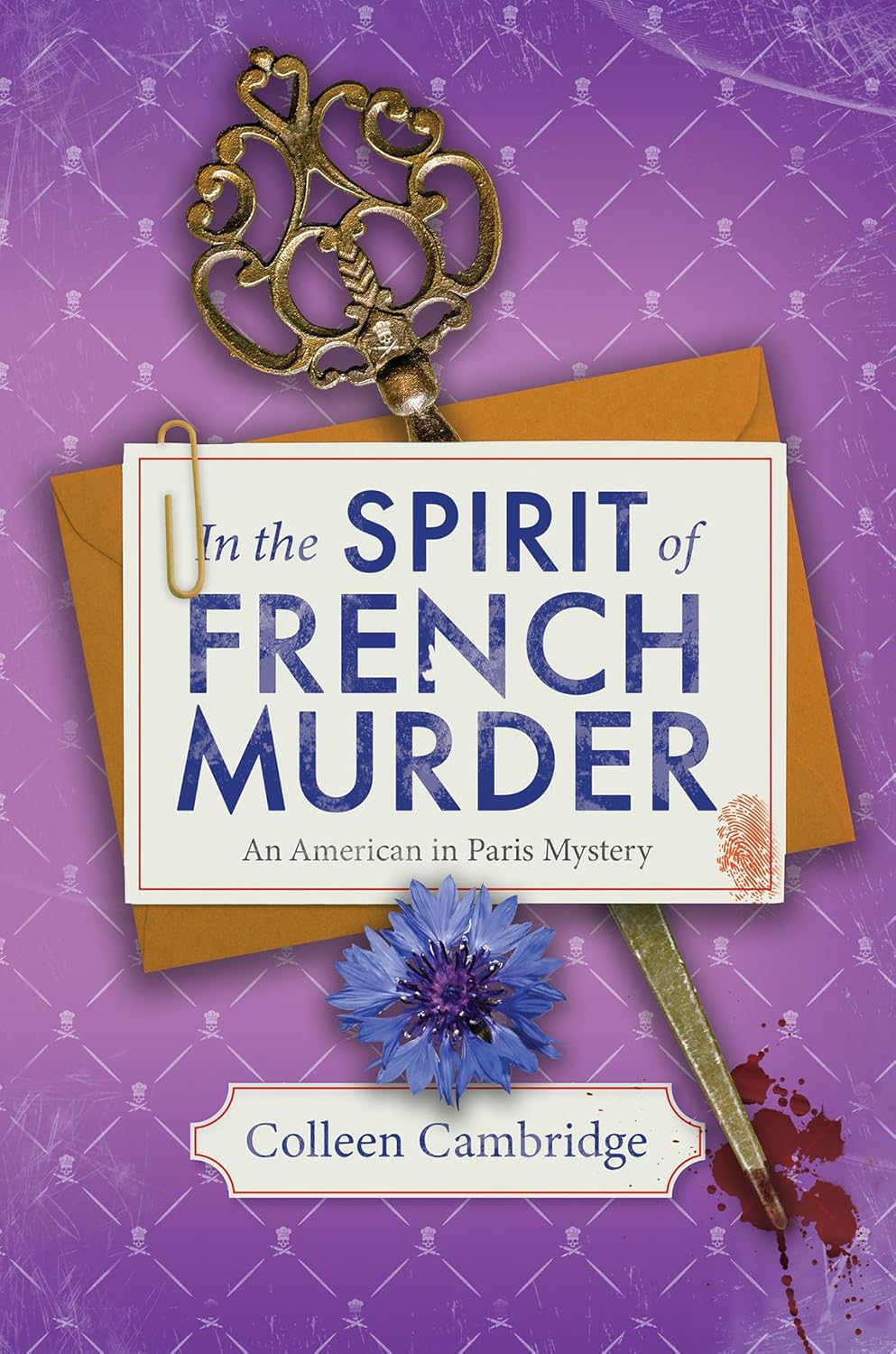 In the Spirit of French Murder is the fourth book in Colleen Cambridge’s An American in Paris Mystery series set in post-World War II Paris, about Tabitha Knight, a former Rosie the Riveter and best friend of Julia Child. At the time this novel takes place, in March of 1950, Tabitha, the daughter of an American policeman father and a French mother, has been in Paris for almost a year. After growing up near Detroit, she has gone to live with her French grandfather and his life partner, Oncle Rafe. Tabitha’s cooking skills are not up to making the French dinners her “messieurs” love, but, luckily for her, she has Julia Child as a neighbor. At this time, Julia is a student at the prestigious Cordon Bleu chef school, and she is happy to cook meals for Tabitha and her messieurs or to direct Tabitha in making them.
As she is returning from Julia’s house one day, after Julia has a rare failure in the kitchen, Tabitha is confronted by a woman leaving her messieurs’ house, warning of danger to them. Tabitha’s grandfather and Oncle Rafe are clearly upset, and unwilling to talk about who the woman is, and what she said to them. Later, the woman follows Tabitha when she goes on a date with Jean-Luc, the veterinarian who helped her rescue an alley cat in the previous book. It turns out this mysterious woman is Madame Vierca, who has a reputation as a medium. She has a cryptic message for Tabitha, saying that nine bluets (a blue flower, like a cornflower) are fading.
Tabitha doesn’t know what to think of this. She doesn’t really believe in mediums and fortune tellers, but she is fascinated by them, and she is afraid for her messieurs. She agrees to meet with Madame Vierca at her house, and Julia insists on accompanying her. Madame Vierca’s fortune for Julia, that she will appear in many living rooms, is very amusing. Julia, of course, has no idea what she’s talking about. Tabitha’s fortune is much darker. The medium knows that she often comes across dead bodies, and predicts that this will happen again, and warns of more danger for Tabitha’s grandfather and Oncle Rafe. She also claims to have spoken to the spirit of Tabitha’s late grandmother, even mentioning an incident that happened when she lived in Michigan, and which very few people knew about. But when Tabitha asks what she meant by the flowers losing their bloom, Madame Vierca doesn’t remember.
Shortly after this visit, Tabitha attends the pre-opening party at the restaurant that her messieurs own, and which they are opening for the first time since the war. Julia and the restaurant’s chef cook the delicious-sounding dinner. The guests are members of her messieurs’ Resistance group. Tabitha is alarmed when she sees a bouquet of nine bluets at the table, and she recalls the medium’s warning. It turns out that the Resistance group was known as the Nine Bluets. During the war, the members of the group had to keep their identities secret, and not all the members were known to each other until the war was over.
After the dinner, one of the Nine Bluets is found stabbed to death shortly after he leaves the restaurant, and one of the bluet flowers is missing from the bouquet and later found with his body. Inspecteur Merveille is called to the scene. As readers of the earlier books will know, Tabitha finds Merveille very attractive, even though he is engaged to be married and she is beginning her own romance with Jean-Luc. In the previous book, Tabitha noticed that the picture of Merveille’s fiancée was missing from his desk. Has the engagement been broken off? I will not spoil it here, but we get an indirect answer to that question in this book. Merveille rarely shows his feelings, so Tabitha doesn’t really know how he feels about her, except that he gets annoyed by her interference in his cases. That seems to be diminishing a little more with each book, though.
Tabitha and Merveille agree that the murderer had to be someone who was at the dinner, which means a member of the Resistance group. Why would one member of the group want to kill another? Tabitha thinks her grandfather and Oncle Rafe are not taking Madame Vierca’s warnings seriously enough. The next day, Tabitha insists on accompanying her messieurs when they visit an empty house, which had served as a safe house for the group during the war. They used it to hide Jews and other refugees until it was safe to get them out of occupied Paris. Another member of the Resistance group is supposed to meet them there, but he doesn’t answer the door. When Tabitha and her messieurs go inside, they find his dead body–and another bluet.
Even though the method of murder is different–this man was poisoned, not stabbed–Tabitha is certain it must be the same killer, and that one member of the Nine Bluets is killing the others. Tabitha and Merveille must find the killer before her beloved messieurs become the next victims. Their search takes them into the dark alleys of the Left Bank and some of the seediest parts of Paris, including a hashish den, a tattoo parlor, and a crowded bar run by a woman. When Tabitha returns to Madame Vierca’s house, the medium has disappeared, leaving behind three tarot cards, which Tabitha interprets as a warning to her: the Devil, the King of Swords, and Death. All very ominous, she knows, but will the message in the cards help her find the killer?
This is a wonderful series, and I absolutely love Cambridge’s descriptions of postwar Paris. The city comes alive for the reader. This book focuses on the work of the Resistance during World War II, and how much danger they faced. Even though the war had been over for five years at the time the book takes place, the memories are still alive for the people of Paris. Tabitha worked at a bomber plant in Michigan, but, even though that was hard and potentially dangerous work, she is amazed and horrified when she learns of all that the Parisians suffered under the Nazi occupation. Her grandfather and Oncle Rafe rarely talk about the war, and it is the only point of contention between them. For Oncle Rafe, the difference between resisting and collaborating is clear-cut, and he sees things in black and white: either you were a resistor or a collaborator, and there was nothing in between. But Tabitha’s grandfather sees the gray areas. He was a banker during the war and had to work with the Nazis. While he pretended to collaborate, he was secretly helping the Resistance.
Each book in the series features a different aspect of French culture: food, wine, and fashion in the first three, and spiritualism in this one. For the first time in the series, there are supernatural elements, and Cambridge brings in several legendary figures from Parisian folklore, such as The Old Man Who Appears After Midnight and Lancelin the Sleeper. These stories are fascinating, and it is up to the reader to decide how “real” they are. We see less of Julia in this book, though. She appears fairly often toward the beginning, and then not again until the end, as Tabitha and Merveille search the Left Bank for clues without her. But her appearances are an absolute delight, as always. Tabitha’s conversations with her help her to straighten things out in her mind, about the case she’s working on. And, of course, Julia makes mouth-watering food in this book, including, besides the dinner at the restaurant, cheese soufflé, coq au vin, and French onion soup. I am looking forward to seeing Tabitha’s and Julia’s adventures continue. — Vicki Kondelik