Essay & Review by Cathy Akers-Jordan
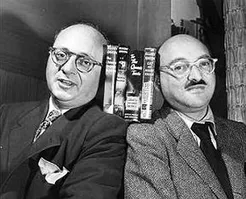
Once upon an time there was a mystery writer whose character was so popular that a letter addressed to the character with just the character’s name and city would arrive at the author’s office. This character starred in books, short stories, public debates, movies, and radio, and even started a ground-breaking magazine that still exists today. Like Sherlock Holmes, some people assumed the character was a real person – yet today that character is not as well remembered as his contemporaries, like Father Brown and Lord Peter Wimsey. You now have all the clues, can you solve the puzzle of the character’s identity?
Fans of the Golden Age will immediately realize the answer is Ellery Queen.
Created by cousins Frederick Dannay and Manfred B. Lee in 1929, Ellery Queen was a groundbreaking character in the Golden Age of mystery fiction. Ellery was mystery writer who helped his father, Inspector Richard Queen, solve unusual cases that baffled the police. While other early authors focused solely on the puzzle, the cousins included character development in their early novels. While other authors withheld clues to make their characters look smart, the cousins played fair by providing the reader with all the clues. They even broke the action and challenged the reader to solve the case before Ellery could. Most cleverly of all, the cousins used the name of their protagonist as their pen name, making it appear Ellery was writing the stories about himself and his police inspector father.
A Note on Pseudonyms: Dannay and Lee are actually pseudonyms. Dannay was born Daniel (David) Nathan. Lee was born Manford (Emanuel) Lepofsky. (They called each other Danny and Manny and their children use the surnames Dannay and Lee.) This is intriguing because in the first EQ book we are told that the names Richard and Ellery Queen are actually pseudonyms used to protect the privacy of the real people behind the fictional characters. Yes, it lends an air of reality but it’s also a subtle hint about the authors.
Literary Motifs
Hallmarks of Ellery Queen’s work that the set the books apart from other authors included the negative clue, the Birlstone Gambit, the challenge to the reader, the key clue, the dying clue, and the double solution.
The Negative Clue, the thing that should be there but is not, was first used by Sir Arthur Conan Doyle in the Sherlock Holmes story “Silver Blaze.” That’s the famous case of the dog that did not bark because it knew the killer. EQ took that idea and ran with it, sometimes referring to it as the negative clue. The missing object was not always noticed during the first search of the crime scene, although, once noted, its absence usually led Ellery to the killer. By their own admission Dannay and Lee were great admirers of Sherlock Holmes. It was only natural that they used some element created by Doyle as a tribute to the master detective. Unlike their other motifs, Dannay and Lee did not return to the negative clue in later novels, possibly because the technique had become so well-known it was trite, and therefore unfair to the reader (i.e., too easy a solution).
In Royal Bloodline: Ellery Queen, Author and Detective Francis Nevins identified a second motif which Dannay and Lee borrowed from Doyle. He referred to this motif as the Birlstone Gambit (based on the name of the manor house in which Doyle’s The Valley of Fear took place). To understand this rather complicated motif, one must be familiar with the Sherlock Holmes novel The Valley of Fear, published in 1915. In a unique plot twist Holmes discovered an unusual relationship between the victim and the killer.
Although Nevins was not specific about all of the elements, a comparison of The Valley of Fear and the appropriate Ellery Queen stories indicated that the Birlstone Gambit involved the following components:
- A victim who is not really dead.
- A body which cannot be identified; the killer may be mistaken for the victim.
- The victim and the killer share a mysterious past involving murder or some other crime.
- The victim and the killer have new identities; their shady past is unknown even to their families.
- The victim turns the tables and becomes the killer in order to get revenge for past actions.
Like the negative clue, Dannay and Lee took the Birlstone Gambit, which Doyle used only once, and molded it into a defining element of their own. They would return to variations on this motif years later in an attempt to recapture the nostalgic Golden Age of the mystery genre. Dannay and Lee’s influence lingers even today. Variations on the Birlstone theme can be seen in such diverse examples as the films Body Heat and Diabolique, and Jonathan Kellerman’s novel Silent Partner. Because Ellery Queen’s popularity declined after the death of author Frederick Dannay in 1982, few mystery readers today realize the origin of this motif, or Dannay and Lee’s contribution to its durability. Indeed, only Francis Nevins, in his extensive analysis of the Ellery Queen books (in Royal Bloodline), has recognized this element of detective fiction and given it a name.
The Challenge to the Reader, unique to Ellery Queen, was a break in the action of the story when Ellery addressed the reader, breaking the fourth wall by switching from third-person to first-person narrative, to indicate that the reader now had all the clues necessary to solve the mystery and challenging the reader to solve it before he did. The reader could put the novel down at this point and try to “match wits” with Ellery. The challenge became a hallmark unique to Ellery Queen and was used in the early books, the long-running radio show, and the last of the three television series (starring Jim Hutton as Ellery Queen in 1975-76).
The Key Clue motif is a clue that allows Ellery to put the whole case together in his mind and see the solution. It’s often something unrelated to the case that triggers a bolt-from-the-blue revelation such as this example from The Scarlet Letters when Ellery is watching a sign painter: “And there came a stroke, as of lightening, and the heavens proclaimed alarms and excursions, and the rains came…” Ellery, dependent on deduction and an obvious admirer of Sigmund Freud, probably understood that the revelation was a result of his unconscious mind continually working on the problem, but he nevertheless appreciated it when it did happen. In later books this moment replaced the Challenge to the Reader but readers could still pause to try to solve the mystery for themselves because it was clear Ellery knew the solution and the denouement would be next.
One of the most recognizable motifs Dannay and Lee used was the Dying Clue: the clue left by the victim which identified the killer. The motif assumed that the victim was thinking clearly enough to leave a message identifying his killer, even if pen and paper are not available. Inspector Queen was never certain of the validity of the dying clue. Ellery disagreed with his father, telling the Inspector: “…Dying men may accuse innocent persons falsely in mystery stories, but in life they show a deplorably simple respect for the truth” (“The Death of Don Juan,” Queen’s Full). The most common objection to the dying clue was, why didn’t the victim simply write the killer’s name? As Ellery explained in the short story “E = Murder”: “The classic objection. The classic reply to which is that he was afraid his killer might come back, notice it, and destroy it” (Queen’s Full). Perhaps because of the various contradictions and objections to this motif, Dannay and Lee avoided the dying clue for years, only to return to it near the end of their career. The appeal of this motif was clear: the authors wanted to believe the human mind was capable of heroic effort at the moment of death, and it was a good way of providing a clue for Ellery and the reader. It was the technique Dannay and Lee used most often, and the variations (such as Ellery’s belief in it, or having the killer leave the clue) kept it fresh and appealing to readers.
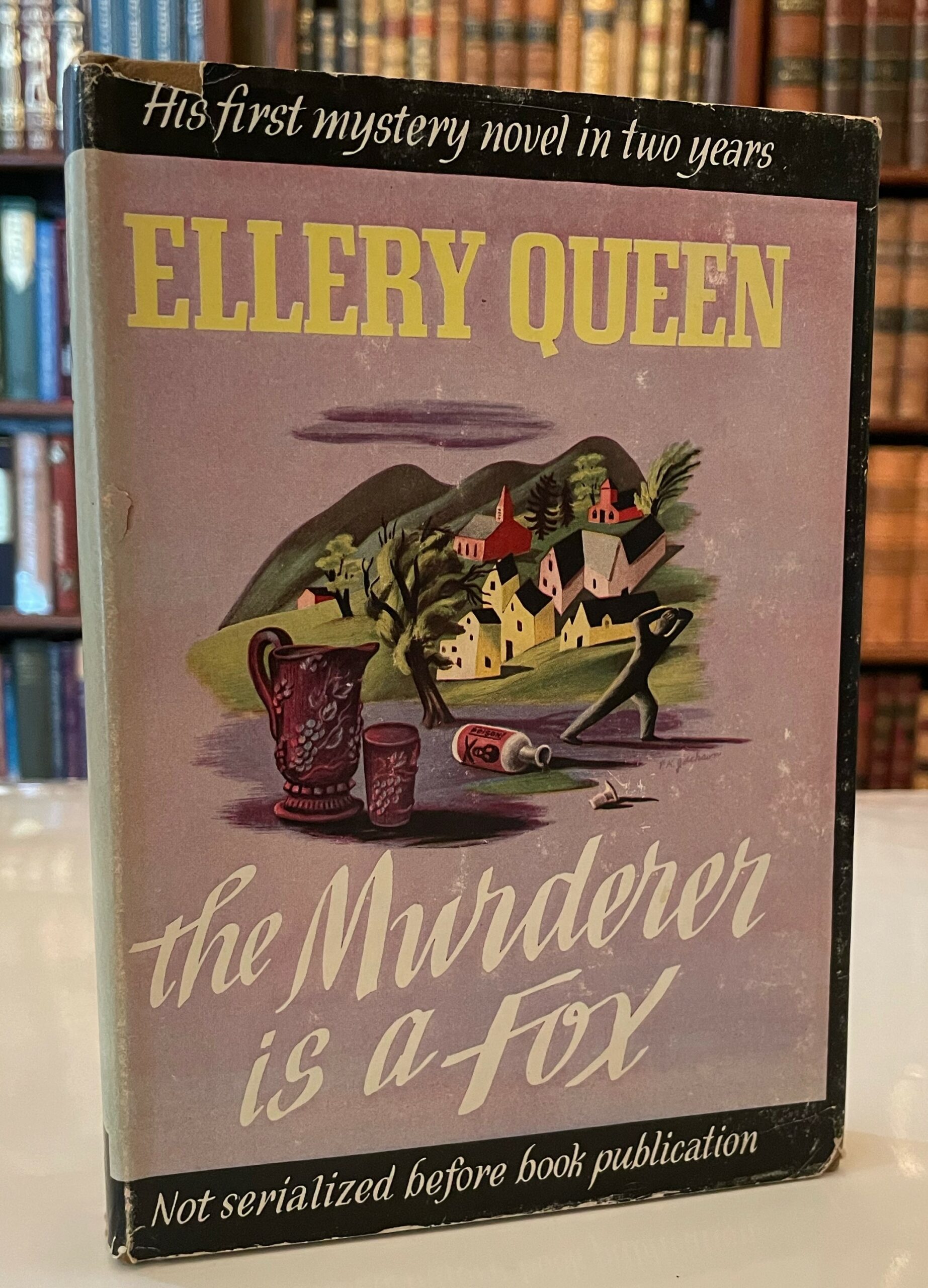
The final motif, the Double Solution, was probably created by Dannay and Lee. After experimenting with having Ellery introduce incorrect solutions before the final correct solution, the authors quickly refined this into the hallmark Ellery Queen double solution: the first solution was correct, but Ellery later revealed a second complication which further resolved the case without contradicting the first solution. In cases with a second solution, Ellery was likely to confront the killer alone to reveal that he knew the whole story. In The Door Between and Ten Days Wonder he not only confronted the killer, but left him with the choice of jail or suicide (before these were trite). Sometimes Ellery kept the second solution a secret from those involved, usually in order to protect them from the psychological damage the full knowledge could cause them. Such was the case in The Murderer is a Fox, when Ellery chose to hide the fact war hero Davy Fox had accidentally poisoned his mother when he was a small child. Dannay and Lee used the double solution almost as often as the dying clue. This technique allowed them to develop complex plots and provide the reader with a surprising twist at the end. Like the dying clue, it was closely associated with the Queen canon, although other authors also used it.
Although many of these motifs are now considered over-used, they were fresh and new when Dannay and Lee created or made use of them. Readers should keep this in mind when re-reading the original Ellery Queen books.
Character Development
When readers first meet the character Ellery Queen in 1929, he’s a young, Harvard-educated, pince-nez wearing, tweed-suited snob. He’s incredibly intelligent and condescending to his father, whom he sometimes addresses as “My dear Watson.” This Ellery is clearly influenced by Sherlock Holmes and S. S. Van Dine’s Philo Vance. Like Holmes, this Ellery is all about deduction, which he calls ratiocination. Since the stories are basically logic puzzles, this characterization of Ellery works well for the first nine books which are essentially logic puzzles typical of Golden Age mysteries.
Starting with Halfway House (1936) the books evolve beyond mere puzzles to more complex, psychological stories. Ellery similarly evolves and becomes less officious and a more realistic human. Instead of simply relying on deduction, he also develops a psychological profile of the killer which him solve the case – something he could NOT do without understanding psychology and human behavior.
Ellery is always portrayed as a young mystery writer in his 30s and amateur detective; as the series progresses the character’s fame in the stories reflects his real-life popularity. This Ellery reluctantly helps police with their most baffling cases and suffers psychologically when he can’t solve a case as quickly as he’d like, resulting in more victims (Cat of Many Tails, 1949, is a prime example).
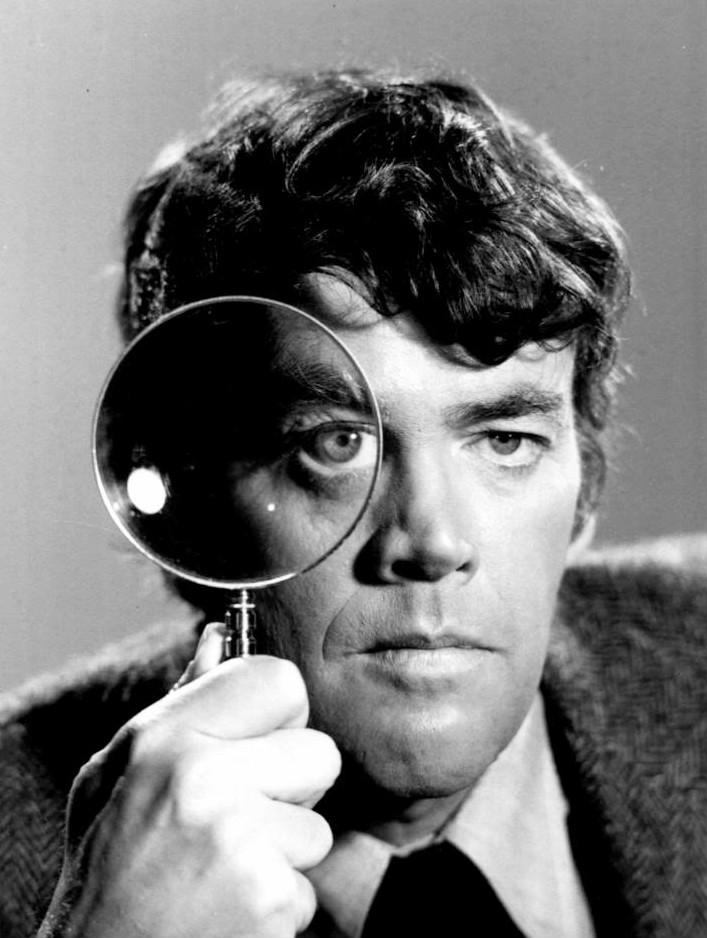
Both literary versions of Ellery are tall, slim, dark haired, and silver-eyed. The pince-nez disappeared as Ellery evolved but he’s always described as well-dressed. Hugh Marlowe, who played Ellery on the radio and in the movies, was called “a perfect casting” by Frederick Dannay himself. The movie version of Ellery varied with the actors who portrayed him but Jim Hutton’s 1975-76 TV series is a fan favorite. Wanting to avoid tweed suits, Hutton chose the wardrobe and while he did wear a tweed coat (and the Irish walking hat described in the books), he was fond of sweaters over an open-collar shirt. Hutton’s Ellery was laser-focused when crime-solving but charmingly absent-minded and hard to distract when focused on his writing, an endearing combination that differs from the books but works very well. The TV series include homages to two works by Dannay and Lee as well as the EQ comics (yes, there were comics, too!).
Who Really Wrote Ellery Queen?
While the majority of the series books were written by Dannay and Lee, at some point Lee developed a severe case of writer’s block and Dannay was busy editing Ellery Queen’s Mystery Magazine. Some books were farmed out to ghostwriters and the quality varied. Of the series books featuring the characters of Ellery and Inspector Queen (the canon), only a few were written by ghostwriters and the quality was excellent. The non-series books, those NOT featuring the characters of Ellery and Inspector Queen, were not so good.
Francis Nevins said that while working on his book Royal Bloodline: Ellery Queen, Author and Detective Dannay admitted the whole story about the ghostwriting scheme and asked that it not be included since it did not belong in an examination of Dannay and Lee’s work. Nevins agreed. In the article “Death and Ghosts” (Dime Novel Roundup, Feb. 1998) Nevins admitted: “But anyone who’d learned from the Queen novels to read with care, noticed the text’s silence about almost thirty novels published as by [Ellery] Queen and the scrupulous listing of every one of those titles in the checklist at the end of my book, must have figured out the truth” (ibid.). He also stated for the record that Dannay and Lee did write the non-series book Cop Out, and that Lee eventually overcame his writer’s block and wrote the last of the Ellery Queen novels.
Given the poor quality of the non-series books by the ghostwriters, it is not surprising that Dannay and Lee regretted the whole scheme and wanted to keep it quiet. It is also understandable that the ghostwriters themselves continued to respect Dannay and Lee’s wishes for silence on the subject, even after their deaths. Certainly Francis Nevins had it right: “…in the long perspective it would have been so much better if Fred and Manny had been able to just say No” (“Death and Ghosts“).
Ellery Queen Mystery Magazine and EQ’s Impact on the Mystery Genre
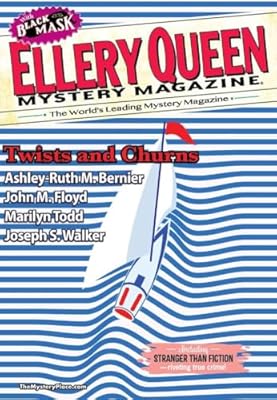 Ellery Queen was so popular that in 1941 the authors created Ellery Queen Mystery Magazine which is still published today. Dannay was the first editor and from the start used EQMM as a place to promote short fiction by previously unpublished mystery authors. Many authors you know and love published their first story in EQMM.
The Mystery Writers of America recognized Dannay and Lee’s contributions the genre with five different awards; an unprecedented record that has not been matched by any other author (or writing team):
- 1946 MWA Best Radio Drama (the first time this award was given) – for The Adventures of Ellery Queen
- 1950 MWA Best Short Story – for ten years’ service through EQMM
- 1961 MWA Grand Master Award – for important contributions in the mystery field over time, and a significant output of consistently high quality material
- 1964 MWA Edgar Allan Poe Award (best novel) – for The Player on the Other Side
- 1979 MWA Special Edgar Award 1979 – celebrating 50th Anniversary of the first EQ novel
In 1983 the MWA established The Ellery Queen Award to recognize writing teams and outstanding people in the mystery-publishing industry; a fitting tribute for the men whose influence helped shape the American mystery for more than fifty years.
A Series Worth Reading and Re-reading
If you like Golden and Silver Age mysteries and have not read Ellery Queen, you are in for a treat. I’m not sure if all the books are still in print but almost all are now available in ebook and Audible format. I recommend focusing on the canon (novels and short story collections that feature the characters of Ellery and Inspector Queen). It’s fun to watch Ellery evolve from a Golden Age academic snob to a Silver Age three-dimensional person, driven by his reputation to solve crimes that stump the police while dealing with the guilt of not always solving them quickly enough to save all of the victims. The result is remarkably close to the character epitomized by Jim Hutton in the 1975-76 TV series which, unfortunately, lasted only one season. That TV also series stands the test of time and hopefully still inspires new readers to explore the original canon.
The Novels
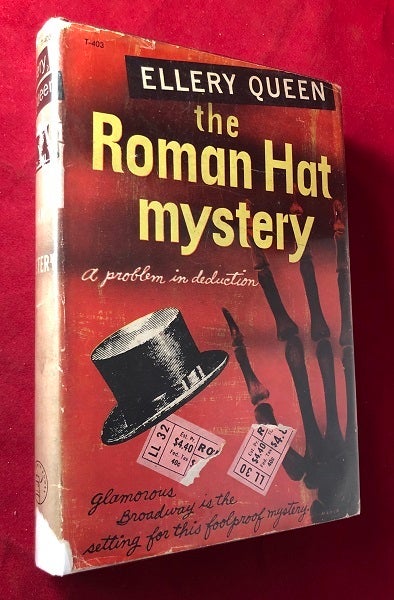 The Roman Hat Mystery (1929)
The French Power Mystery (1930)
The Dutch Shoe Mystery (1931)
The Greek Coffin Mystery (1932)
The Egyptian Cross Mystery (1932)
The American Gun Mystery (1933)
The Siamese Twin Mystery (1933)
The Chinese Orange Mystery (1934)
The Spanish Cape Mystery (1935)
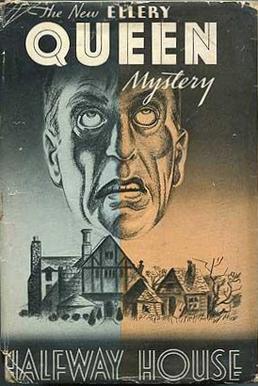 Halfway House (1936)
The Door Between (1937)
The Devil to Pay (1938)
The Four of Hearts (1938)
The Dragon’s Teeth (1939)
Calamity Town (1942)
There Was an Old Woman (1943)
The Murderer is a Fox (1945)
Ten Days Wonder (1948)
Cat of Many Tails (1949)
Double, Double (1950)
The Origin of Evil (1951)
 The King is Dead (1952)
The Scarlet Letters (1953)
Inspector Queen’s Own Case (1956)
The Finishing Stroke (1958)
The Player on the Other Side (1963)
And on the Eighth Day (1964)
The Fourth Side of the Triangle (1965)
A Study in Terror (1966)
Face to Face (1967)
The House of Brass (1968)
The Last Woman is His Life (1970)
A Fine and Private Place (1971)
Short Story Collections
The Adventures of Ellery Queen (1934)
The New Adventures of Ellery Queen (1940)
The Case Book of Ellery Queen (1945)
Calendar of Crime (1952)
Q.B.I.: Queen’s Bureau of Investigation (1955)
Queen’s Full (1965)
Q.E.D.: Queen’s Experiments in Detection (1968)
Happy reading!
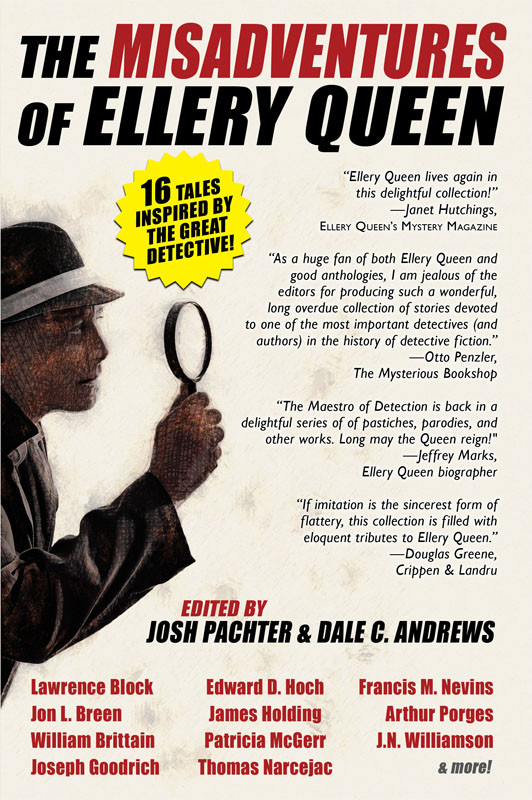 The Misadventures of Ellery Queen and The Further The Misadventures of Ellery Queen, Josh Pachter and Dale C. Andrews, eds. (Editor’s note: This is published by Wildside Press, one of the premier small presses for short mystery fiction.)
I was thrilled to discover not one but two anthologies of Ellery Queen pastiches and parodies!
A Note on the Titles: In 1944 Ellery Queen (Frederick Dannay and Manfred B. Lee) published The Misadventures of Sherlock Holmes, the first collection of Holmes pastiches and parodies. The sons of Sir Arthur Conan Doyle threatened legal action and the book was pulled after the first edition — until it was republished in 1991 (after Doyle’s copyright expired). What better name for a loving collection of EQ pastiches and parodies than a homage to EQ’s own love of Sherlock Holmes? Unlike Doyle’s sons, Dannay and Lee’s sons approved of these anthologies. The title is also nod to a collection of Dannay and Lee EQ stories The Adventures of Ellery Queen (1934).
These two collections of pastiches and parodies will delight fans with a clever mix of stories featuring Ellery Queen, from the young pince-nez-wearing Ellery of the Golden Age, to the silver age Ellery depicted by Jim Hutton in the beloved 1975-76 TV series, to a seventy-something Ellery who ages in real time. The wide variety of authors include Dannay and Lee themselves, their ghostwriters, assorted mystery writers, and scholars and all are well-worth reading. Many of the stories were originally published in EQMM but two are translations (one from French, one from Chinese).
While I loved both collections I want to mention a few stories that I particularly enjoyed:
“The Reindeer Clue” by Edward D. Hoch. Interesting because it was originally published as EQ story and Hoch was never named as the ghostwriter – until now.
“The Ten-Cent Murder” by Joseph Goodrich. Features Dashiell Hammett and Frederick Dannay who really did teach at the Jefferson Institute in Manhattan. So clever!
“Once Upon A Crime” by Maxwell E. Siegel. EQ is a real person, Dannay, Lee, and Barnaby Ross (another Dannay and Lee character) are pseudonyms. Pince-nez EQ is married to Hollywood columnist Paula Paris (from The Four of Hearts, 1938), ages in real time (age 51 in this one) but writes about 30-year-old Ellery, who is working on fairy-tale themed story. This story also refers to Ellery’s first wife and son (EQ, Jr) who now live in Italy. (NOTE: In the first few novels it’s hinted that Ellery is married, has a child, and retires to a small Italian village with his wife, child, and father — but this was never portrayed in the books where he was always a bachelor. A series of EQ, Jr. books, featuring the Queens’ houseboy Djuna, were written by a ghostwriter so Siegel’s references to all this, especially to Ellery’s son writing the EQ Jr books, is pretty clever.)
“The Mad Hatter’s Riddle” by Dale C. Andrews. 75-year-old Ellery solves a murder on the set of the 1975-76 TV show. David Wayne is mentioned but neither he nor Jim Hutton appear in the story. This pastiche includes characters from one of EQ’s Hollywood novels, The Four of Hearts (1938). NOTE: The episode being filmed in the story is based on an actual EQ story.
“The Little Sister in Crime” by Theodore B. Hertel, Jr. Ellery attends Bouchercon with Perry Mason, Barnaby Ross, Nick and Nora Charles, Phillip Marlowe, Nero Wolfe, and Archie Goodwin. Barnaby Ross is murdered. Hilarious dialog includes Ellery explaining that he hired two cousins in New York to ghostwrite stories based on his cases but “if they ever get tired of doing it, there are plenty of others who’d be willing to take over and use my name.”
“The Mistake on the Cover OF EQMM #1” by Arthur Vidro. Yes, there really was mistake on the cover of EQMM #1 and Vidro does a fantastic job working it into the story.
“The Misadventures of Ellery Queen” by Ellery Queen. Yes, actually written by Dannay and Lee, found in Danny’s papers at Columbia University. The story stars Frederic Dannay and Manfred B. Lee!
In Afterward to his story “Open Letter To Survivors” Francis M. Nevins laments the decline of EQ’s popularity after the authors’ long-time influence in the genre: “I can’t believe I’ve lived to see one (or, if you count Fred Dannay and his cousin and collaborator Manfred B. Lee separately, two) of the most important authors of my formative years fall into obscurity. Will this anthology help return to Ellery the prestige he deserves? Will e-books or some other high-tech medium we haven’t yet dreamed of restore the author(s) and character to the central position they enjoyed for years before I was born and for much of my lifetime? Many of us are trying to achieve that goal. I see this anthology as a step in the right direction.”
You speak for all EQ fans, Mr. Nevins, and we hope you are right! I’m already hoping for another Misadventures anthology!
*****
 Cathy Akers-Jordan is a teaching professor at the University of Michigan-Flint where she wrote her Master’s thesis on the works of Ellery Queen. A portion of that thesis was used for this article. A different portion is featured on Ellery Queen, A Website On Deduction where is she one of the West 87th Street Irregulars (http://queen.spaceports.com/Irregulars_12.html).