Jane Harper: The Dry
 Two things to keep in mind when reading The Dry:
- It’s an awesome book to read in the cold, cold winter, as it’s set in the burning draught of Australia as meticulously delineated by Jane Harper.
- If you start reading it early in the evening, forget about getting any sleep. You won’t be able to put it down.
This is a wonderful first novel, featuring Melbourne financial detective Aaron Falk, who has returned to his tiny hometown of Kiewarra for the most tragic of reasons: his boyhood friend, Luke, has apparently killed his wife and toddler son in a murder-suicide. Aaron has gotten a note from Luke’s father demanding his attendance at the funeral. As he arrives, it’s like he’s walking into a terrible steam bath. Harper wraps the suffocating heat around him like a blanket and he’s plunged into the tiny church where the funeral is being held, surrounded by his long ago neighbors and frenemies.
 Doug Allyn has long been known as one of the masters of the modern mystery short story—it’s probably harder to find an issue of Ellery Queen’s Mystery Magazine that doesn’t have an Allyn story in it than to find one that does, and it’s a rare year that he’s not nominated for an Edgar award. But he’s also a fine novelist as well, my personal favorite being the the Mitch Mitchell series, which feature a female Michigan based deepwater diver.
 Laura Joh Rowland is well known to mystery fans as the author of the Sano Ichiro mysteries set in 17th century Japan. She’s also taken on Charlotte Bronte in other novels, and here she creates a new character, photographer Sarah Bain, who lives in Victorian London at the same time as Jack the Ripper. While there are many, many books about Jack the Ripper—the fact that he was never found will always be fuel for speculation—he’s almost like Sherlock Holmes in that the permutations and impressions of his life (and crimes) are varied and plentiful, and the interpretations can range from the dull to the nutty to the creative. Rowland goes for the creative.
 Ever since the loss of Ann Rule, the True Crime world has been in a bit of a funk. To some extent the books that used to come out by the dozens have been replaced by semi-documentaries that proliferate on television. Of course, like so many, these programs suffer from a lack of depth and a questionable “reality” show standard of journalism. So thank goodness for Rule’s friend Kathryn Casey, who with her new book Possessed: The Infamous Texas Stiletto Murder serves up a delectable slice of real life crime, detailed research, twisted personality and plain old you-couldn’t-make-this stuff-up goodness.
 I like starting a new year with a new discovery. I read an advance reading copy of this novel, which I plucked from the giant slush pile we have of such books. Sometimes one will call to me, and this one did. It feels very much like a series book though it apparently is not (that would be my one objection). Set in San Francisco, we meet homicide cop Gavin Cain, who is called in by the mayor after the mayor receives some compromising photographs with a request from the anonymous sender that the mayor do the world a favor and kill himself. When Gavin has his initial meeting with him, the mayor denies knowing anything about the photographs, which show a woman handcuffed, then undressed and obviously drugged.
 Carrie shared the manuscript of this novel with me – I inhaled it and loved it and then didn’t (or forgot to) write my review. I had to come back to it and re-read it thoughtfully. I still love this book and this author. Carrie is part of a long line of beloved authors (for me at least) that include Lillian O’Donnell, Barbara D’Amato, Leslie Glass, Lynn Hightower, and Lee Martin/Anne Wingate, women who wrote about female police officers or detectives who are juggling family and personal issues along with the day to day sexism they encounter on the job. O’Donnell’s first novel was published in 1972 and the sexism doesn’t seem to have changed much.
 Nancy Herriman has taken a very specific time and place and brought it to life. Her central series character, Celia Davis, British born, has served as a nurse in the Crimea. Through marriage, she’s ended up in 1867 San Francisco, as the man she married was a hot blooded Irishman looking to make his fortune in the gold rush. He has vanished – he may be dead, or he may not be dead, but Celia is running a clinic on her own and serving as guardian to her cousin, Barbara, who is slightly crippled as well as half Chinese. In 1867 San Francisco, being Chinese was far more of an impediment than being crippled.
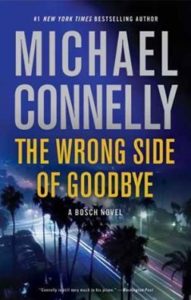 It’s been awhile since I’ve enjoyed a Michael Connelly book as much as I enjoyed this one. I always enjoy them, don’t get me wrong, but some of the fizz was gone for a couple books there. It seems to be back in a big way in this new Harry Bosch novel, where Bosch takes on not one, but two, cases and arrives at a meaningful and satisfying solution for each one.
 First of all, kudos to Ruth Ware for not calling this “The GIRL in Cabin 10”. Thank you, Ms. Ware, for writing a book about adults and referring to them as such. Second of all, I was a huge fan of her first novel, In a Dark, Dark Wood, and this one is even better. No kidding. The skills she brought to her first novel are both refined and sharpened here.
 Mystery writers have always, throughout time, held an unflinching mirror to their contemporary society. Alex Marwood, much like her brilliant contemporary Laura Lippman, is exceptionally good at this. I think one of the keys is not to hold the society or whatever parts of it you are writing about in actual contempt. There’s an element of familiarity, that, if done well, should make a reader uncomfortable. Of course mysteries also add in the element of an extreme event, obviously a murder, and the reactions of the characters to this event factor in to the plot. If done well you are putting yourself in the shoes of the characters and feeling maybe the fit is a little too close.