Carrie Smith: Forgotten City
 Carrie shared the manuscript of this novel with me – I inhaled it and loved it and then didn’t (or forgot to) write my review. I had to come back to it and re-read it thoughtfully. I still love this book and this author. Carrie is part of a long line of beloved authors (for me at least) that include Lillian O’Donnell, Barbara D’Amato, Leslie Glass, Lynn Hightower, and Lee Martin/Anne Wingate, women who wrote about female police officers or detectives who are juggling family and personal issues along with the day to day sexism they encounter on the job. O’Donnell’s first novel was published in 1972 and the sexism doesn’t seem to have changed much.
 Nancy Herriman has taken a very specific time and place and brought it to life. Her central series character, Celia Davis, British born, has served as a nurse in the Crimea. Through marriage, she’s ended up in 1867 San Francisco, as the man she married was a hot blooded Irishman looking to make his fortune in the gold rush. He has vanished – he may be dead, or he may not be dead, but Celia is running a clinic on her own and serving as guardian to her cousin, Barbara, who is slightly crippled as well as half Chinese. In 1867 San Francisco, being Chinese was far more of an impediment than being crippled.
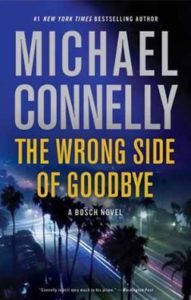 It’s been awhile since I’ve enjoyed a Michael Connelly book as much as I enjoyed this one. I always enjoy them, don’t get me wrong, but some of the fizz was gone for a couple books there. It seems to be back in a big way in this new Harry Bosch novel, where Bosch takes on not one, but two, cases and arrives at a meaningful and satisfying solution for each one.
 First of all, kudos to Ruth Ware for not calling this “The GIRL in Cabin 10”. Thank you, Ms. Ware, for writing a book about adults and referring to them as such. Second of all, I was a huge fan of her first novel, In a Dark, Dark Wood, and this one is even better. No kidding. The skills she brought to her first novel are both refined and sharpened here.
 Mystery writers have always, throughout time, held an unflinching mirror to their contemporary society. Alex Marwood, much like her brilliant contemporary Laura Lippman, is exceptionally good at this. I think one of the keys is not to hold the society or whatever parts of it you are writing about in actual contempt. There’s an element of familiarity, that, if done well, should make a reader uncomfortable. Of course mysteries also add in the element of an extreme event, obviously a murder, and the reactions of the characters to this event factor in to the plot. If done well you are putting yourself in the shoes of the characters and feeling maybe the fit is a little too close.
 Sometimes the cultural zeitgeist affects writers even more than others, and this year I’ve read several novels addressing sexual violence and even more specifically, the rape culture that exists on college campuses. Jamie reviewed two recent memoirs, The Red Parts and Jane Doe January, involving real cases, and I was captivated earlier in the year by Allison Leotta’s The Last Good Girl. Hank Phillippi Ryan is now joining the fray with her latest, Say No More.
 This is a terrific debut novel, set in Springfield, Illinois in 1837. Abraham Lincoln, newly minted lawyer, arrives in town looking for a place to stay. He ends up sharing the bed (a common practice at the time) of one Joshua Speed, who is running the general store in town. Speed and Lincoln became lifelong friends; his brother, James was named U.S. Attorney General by President Lincoln. When this book takes place, however, Lincoln’s presidency is far in the future, though the character traits that assured his greatness are hinted at here.
 It’s always puzzling to me why a particular book takes off for the stratosphere, and another, equally good, does not, but there’s no denying the popularity of Paula Hawkins’ debut, The Girl on the Train. While I’ve heard Hawkins say in an interview that no one ever thought of a character seeing a crime from a train before (see The 4:50 from Paddington, Agatha Christie, 1957), I have also seen an interview in the New York Times Book Review where she mentions a reverence for Ruth Rendell. There are also articles talking about this novel being responsible for the “re-birth”of domestic suspense, a trend that has always been with us, going back, again, to Agatha herself. All that made me unwilling and uninterested in reading it, but I put it on our book club ballot and the book club picked it, so here I am, having read the most popular novel published in the last few years.
 Mr. Keyse-Walker is the winner of the Mystery Writers of America/Minotaur Books First Crime Novel award (the award being publication), so I turned to it with some interest. Past winners of Minotaur/St. Martin’s contests include Steve Hamilton, Michael Koryta and Julia Spencer-Fleming, so the bar is somewhat high. I was at first jarred as I opened a novel set on tiny Anegada, a remote member of the British Virgin Islands. The main character is special constable Teddy Creque, who is a native islander. The author, a lawyer from Ohio, couldn’t seem more removed from his character, but then I decided the guy who wrote Memoirs of a Geisha wasn’t very much like his character either, so I settled in.
 At this point in Tasha Alexander’s career, now eleven novels in to her Lady Emily series, you’re either all in or all out. I am all in as Lady Emily makes her way around Victorian Europe solving crimes with the help of her dashing husband, Colin Hargreaves. As most loyal readers will know, Lady Emily was widowed in the first novel, And Only to Deceive, falling in love with her husband only after the fact. She ends up mirroring and following his passion for the classical world.