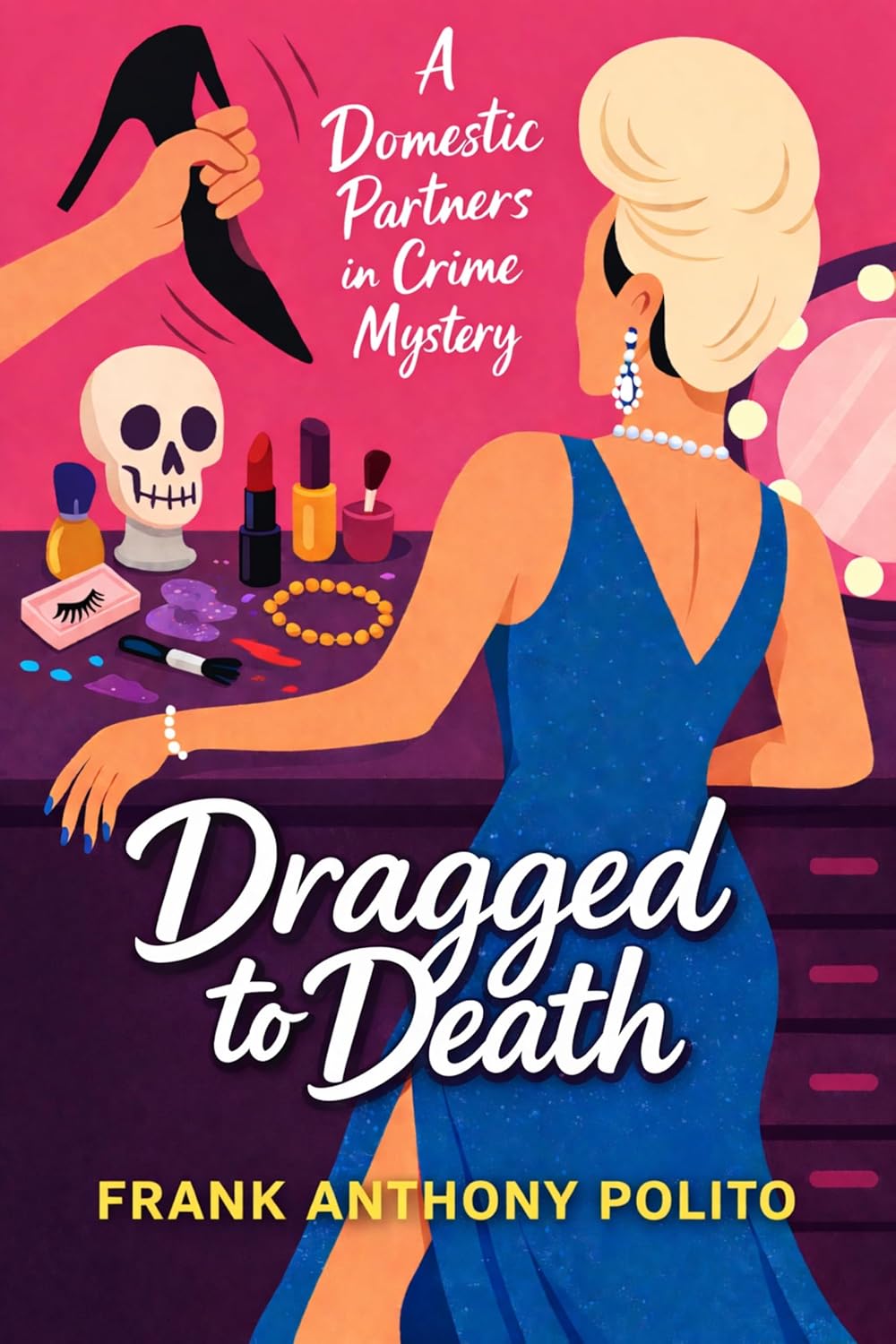
Frank Anthony Polito is a Detroit area writer whose “quozys” are a delightful tour of southeastern Michigan. In book four in his Domestic Partners in Crime series, he takes a loving look at the drag show scene. If you are in the mood for a Detroit based cozy, this is the series for you. Happily, Frank agreed to answer a few questions.
 Q: How did you come to writing mysteries? – I know you’ve written other things. Were you always a fan?
A: I’ve always been a fan of mysteries. Growing up I watched The Hardy Boys on TV and read every Encyclopedia Brown book. But I’d never really thought about writing a mystery novel myself. Then, around 2020, my editor at Kensington reached out and mentioned they were looking for someone to write a gay cozy mystery series and thought I might be a good fit.
Q: Your series features a couple with an HGTV type show, and looking at your bio, I see you and your husband purchased your home on a “House Hunters” episode. Can you talk about that experience?
A: After living in New York City for over 18 years, my real-life domestic partner, Craig (we aren’t married, though after 36 years together we might as well be!) and I decided to move back to our native Detroit so that we could buy a house, adopt a dog, and do all those “normal” things we had never thought we’d ever do. To prepare, we started watching “House Hunters” and I thought “We should apply!” thinking they’d never pick us—and they did. So, over the course of a week we looked at 3 different houses in Royal Oak and Pleasant Ridge, while a camera crew followed us around, documenting the experience. It was super fun, and Craig and I both have acting backgrounds, so acting naturally on-camera and doing re-takes came pretty easily. I, of course, took on the role of the neurotic one, and maybe I even played it up a bit because why not? Every House Hunters couple has one!

Q: The two main characters in your book are a gay couple, and I think your books fit into a newish genre referred to as “Quozy”. What are your thoughts on that classification? Do you embrace or reject it?
A: I love the term. I think it’s very clever, but a lot of folks I run into have never even heard the word “cozy” mystery, so I always explain it as “quozy (queer cozy)” just to make it clear, One thing I’ve found, though, is that the majority of my readers are straight women. For some reason, gay male readers who took to my first novels almost 20 years ago either don’t know that I’ve written these new cozies, or they’re too busy reading gay romance, which seems to be the genre that all the young, gay Bookstagrammers are posting about.
Q: Your first three books were published by Kensington, a major publisher (congrats). But the publishing industry is a harsh one. You are now self publishing, and I think so much is changing in the publishing universe that self publishing is no longer a dirty word. Can you talk about your publishing journey a bit?
A: How much time/space do we have? Lol. But seriously… My publishing journey is a bit unique. Most writers will write a book, then find an agent who will sell it to a publisher. With me, I was working at Kensington Publishing as a freelance publicist, right before I went off to grad school at Carnegie Mellon to study Playwriting. Before I left, my now-editor asked about the plays I’d written. There was only one, a two-hander called Band Fags! about two gay teens growing up in the 1980s, based on me and my best friend. He said he thought it would make for a great novel, and then 2 years later, when I returned to NYC from Pittsburgh, he offered me a contract to write it.
The book came out in 2008 and was very well-received by the LGBTQ community. I got a lot of press and I’m pretty sure that somewhere it said it was the most-read book of that summer. My editor offered me a contract to write a follow up, Drama Queers!, which was released in 2009, and later won the Lambda Literary Award for “Best Gay Romance.” And then… after 2 books without one, I signed with an agent.
Cut to 2011: after writing a Young Adult novel called Lost in the ’90s, and proposals for two other YA novels, I parted ways with my agent when he couldn’t sell any of them. I like to think it had nothing to do with my writing, but regardless it was a very big disappointment. I ended up self-pubbing Lost in the ’90s in 2012, and I thought that my past “success” would help the book sell. It didn’t. Because, back then, self-pubbing a book meant that you were a terrible writer who couldn’t get published by a “real” publisher, and you couldn’t get an agent, which wasn’t true in my case. But no one would even review a self-pubbed book, unless of course you paid them, which I wasn’t about to do because the point was to make money, not spend it.
After that, in 2013, I self-pubbed another book that I’d written and that my agent couldn’t sell to a publisher, a follow up to Drama Queers! called The Spirit of Detroit. And then I was done. I didn’t write another novel, instead focusing on screenplays—that I also haven’t been able to sell, despite working with an Academy Award-winning producer and also with a manager at top literary agency in Los Angeles—until 2020 when my editor at Kensington reached out about writing the cozy mystery series.
Q: What have you learned from the publication of your first book to this one? What are you taking forward as you work on the next book?
A: The biggest thing I’ve learned about having any sort of artistic career (first as an actor, now as a writer) is that things don’t progress in a liner way, like they do in most professions. My first book was a “hit,” the second won a big award, then the third, no publisher wanted it. All of the editors that my agent pitched it to, I’m told, said the book was fun, well-written, and that I’m no doubt a talented writer. But back in 2012, a story set in the 1990s didn’t seem like it would sell.
Now, almost 15 years later, I still don’t have an agent. Over the past two years I’ve written two new novels—one is a queer cowboy romance, the other is a LGBTQ middle grade—and I’ve been querying and querying and querying agents, more than I can count. I’ve gotten some interest from a few, but a majority have been passes. The thing about agents, and publishing in general, is that no one cares about what you’ve written in the past or how “successful” it was – all they care about it what you put in front of them right now.
Q: In the first books, your characters Peter and JP have worked in the theatre, on a house flip, and shooting one of their shows in a “haunted” house. In this outing the guys are part of a charity drag show, and you take readers inside that world. Can you talk about that? What did you want readers to take away from reading about that world?
A: Craig and I love RuPaul’s Drag Race! Back in our NYC days, we used to gather with friends for watch parties, and now, at home, we watch every Friday night, with a drink in hand, cuddled up on the couch with our dogs. We have actually never been to an actual drag show, because, like JP in Domestic Partners, I have a fear that a drag queen will call me out and embarrass me in front of everyone in the audience. But for Dragged to Death, I thought it would be fun to take readers into the behind-the-scenes world of performing and theatre, and I imagined what it would be like it Craig and I (the basis for JP and PJ) got involved with a drag show, and were put in drag, and what that experience might be like. If there is one thing I’d like readers to take away from reading this book it’s the camaraderie and the sisterhood that drag queens build with each other. They are like family—and there are actual drag families with drag mothers and drag daughters and drag aunties and grandmas—and no matter how fierce the competition, they’ve got each other’s backs.
Q: What’s important to you as you portray Peter and JP’s relationship? In lots of detective novels there’s some kind of conflict between the couple but Peter and JP seem to have a lovely relationship, no issues. Do you have an arc in mind for them character wise?
A: Because Peter and JP are based on me and my partner, Craig, what’s most important to me is that their relationship feels loving, believable, and lived-in. I’m less interested in manufacturing conflict between them just for the sake of drama, and more interested in portraying a couple whose relationship is a real source of warmth, humor, and stability within the mystery. They are both protective of each other and when danger threatens they will do what it takes to spare the other one from harm.
Their arc is about how they continue growing within the relationship. Peter is more impulsive and emotionally reactive, while JP is steadier and more grounded, so the evolution comes from how they balance each other and show up for each other more fully under pressure. The tension comes less from romantic dysfunction and more from the outside world pressing in. Their love is the anchor, not the obstacle.
Beginning with book 1, Renovated to Death, we’ve learned that they are engaged to be married, and it’s only a matter of time before they finally wed. Originally I had hope to include their nuptials in book 5, Decorated to Death, before the series was pre-empted. But now that I’m self-publishing the series, who knows what could happen?
Q: How are you going to market this book as opposed to the first three in the series? How do you get this book into the hands of readers?
A: This is the biggest challenge when it comes to self-publishing. Without the backing of a traditional publisher, with connections and money to spend, the only way that I can reach readers is through word-of-mouth. I can’t afford to drop $200 on an ad. I’d have to sell at least 50 books to recoup that investment. Fortunately the series received a lot of support in the cozy mystery Bookstagram community, so I’ve been reaching out and asking folks who’ve posted about it before if they wouldn’t mind showing Dragged to Death a little love when it comes time for its release.
Q: Can you talk about a book that was transformational to you as a writer or as a reader?
A: A transformational book for me was The Mysteries of Pittsburgh by Michael Chabon, which I read right out of college. It was the first mainstream book I’d ever read that featured a gay relationship and it showed me that queer love and desire could exist in a literary novel with beauty, complexity, and emotional truth. It made me feel seen, but it also made me feel that this kind of story was possible for me to write, too. In many ways, it helped inspire my own novel The Spirit of Detroit, particularly in its emotional tone and its exploration of youth, longing, and identity.
Q: Finally, what’s next for Peter and JP? You did leave a big hint at the end of this book!
A: As mentioned, I do have an idea for book 5, Decorated to Death, in which Peter and JP plan their long-awaited wedding. Their anniversary is December 23rd, same as mine and Craig’s, so the ceremony falls amid the holiday season in Pleasant Woods. In the days leading up to Christmas, their dear friend and neighbor, the town mayor, is electrocuted at the annual tree lighting ceremony, which the local police detective deems a tragic accident. But, of course, Peter and JP know better, and they step in to help catch the killer.
Honestly, I have no idea if I’ll ever get around to writing this book. At this point, I’m focused on signing with an agent and selling my queer cowboy romance. The odds that another publisher would pick up book 5 of a series that has been cancelled after 3 books and book 4 is a self-pub are very small. But one never knows, does one? All I can say is follow me on Instagram and Facebook for updates: @frankanthonypolito
***************
Frank Anthony Polito is an award-winning author and playwright. His novels include Band Fags!, Remembering Christmas and The Spirit of Detroit, among many others, and his plays have been produced around the country. He holds an MFA in Dramatic Writing from Carnegie Mellon and a BFA in Theatre from Wayne State. Currently he resides in historic Pleasant Ridge, Michigan, with his partner, Craig Bentley, and their two dogs, Jack and Clyde. They live in a 1924 Craftsman Colonial that they purchased on HGTV’s House Hunters and have been renovating together since 2013. Readers can visit his website at www.frankanthonypolito.com.