Wrexford & Sloane #10
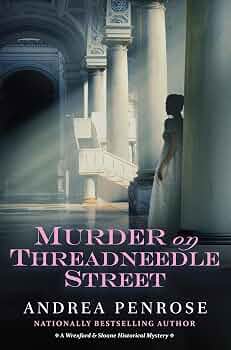 Murder on Threadneedle Street is book 10 in Andrea Penrose’s wonderful Wrexford and Sloane Regency mystery series. The protagonists are the Earl of Wrexford, a chemist with a special expertise in metallurgy, and his wife Charlotte, formerly Sloane, an artist and political cartoonist who uses the pseudonym A.J. Quill. It is an attraction of opposites between the two. He solves crimes by using logic and the scientific method, while she uses intuition and an artist’s eye for details. Over the course of the series, they have each come to respect, and occasionally use, the other’s method.
Just as important as the leading couple is their extended family and circle of friends. Wrexford and Charlotte have a group of four young wards, collectively known as the Weasels. Raven and Hawk are two former street urchins the couple took in and raised as if they were young aristocrats, even though the boys often go out into the streets of London in street urchin garb to help Wrexford and Charlotte solve cases. Occasionally Charlotte joins them, dressed as a street urchin named Magpie. Several books before this one, Raven and Hawk were joined by Peregrine, a boy of mixed race who is the heir to an earldom and was adopted by Wrexford after his nearest relative rejected him because of the color of his skin. The book before this one introduced the latest addition to the Weasels: a girl named Eddy, Wrexford’s half-sister he didn’t know existed until then. There is some doubt as to whether Wrexford’s father was married to Eddy’s mother following the death of Wrexford’s mother, and the marriage documents, if they ever existed, have disappeared. Eddy likes to disguise herself as a boy and resents any effort to make her a proper young lady.
Hawk and Peregrine have welcomed Eddy into the group of Weasels, but Raven, the oldest of the children, has a hard time accepting her presence in the family. Things become complicated in this book because we can tell that Raven has developed a crush on Eddy, even though he doesn’t realize it himself. That might have been the source of the difficulties in the first place. Wrexford has insisted that Eddy not join the boys in their adventures on the streets of London because he wants to protect her, and Eddy chafes against this restriction, which becomes the source of frequent tensions in this book.
Besides the Weasels, Wrexford and Charlotte’s inner circle includes another couple, Sheffield and Cordelia. Sheffield is a seemingly empty-headed former rake who is actually quite brilliant and has become an entrepreneur—discreetly, because the nobility is not supposed to engage in business. Cordelia is a mathematician who tutors Raven. Each of the Weasels has his or her own talent: Raven’s is mathematics, Hawk’s is botanical drawing, Peregrine’s is mechanical devices, and Eddy’s is art and working with messenger pigeons. Other members of the circle of family and friends are Charlotte’s formidable Aunt Alison, who has recently taken a liking to Eddy, the Scottish surgeon Basil Henning, who is often called on to perform autopsies, Griffin, a Bow Street Runner, and von Münch, a mysterious man from a German state who poses as a librarian and who is really an international spy. These friends help the Wrexfords with their crime-solving in various ways.
One of the strengths of this series is that each book focuses on a different aspect of Regency science and technology (or later technology that had its origins in the Regency). Previous books have featured steamships, locomotives, suspension bridges, and telegraphs. This book focuses on counterfeiting, and the Bank of England’s efforts to create the “Inimitable Banknote,” a banknote that cannot be counterfeited. After the end of the Napoleonic Wars—the book begins shortly after Waterloo—paper currency has grown increasingly important, but the problem is that it’s easy for a skilled engraver to counterfeit. The Bank of England, along with the Royal Society, is sponsoring a competition to create the Inimitable Banknote, offering 20,000 pounds to the winner. This is an enormous sum of money—twice Mr. Darcy’s annual income, as fans of Pride and Prejudice will know.
At the beginning of the book, Hawk is very upset when he finds that his drawing teacher, Fletcher Campbell, has been murdered in Threadneedle Street. At first, it seems that his death is a robbery gone wrong, and Hawk is afraid no one will investigate and bring the killer to justice. But Wrexford agrees to help discover the killer. It turns out that one of Raven and Hawk’s street urchin friends witnessed the murder. He never saw the killer’s face, but a valuable ring was taken from Campbell, and Wrexford soon learns that the ring is tied to a group of counterfeiters who were part of a scheme to defraud the government during the Napoleonic Wars. This group substituted real banknotes meant to pay British troops in Lisbon with counterfeit notes and hid the real banknotes away. The leaders, including Campbell’s brother, have been executed, but Wrexford suspects that not all the members of the gang have been caught, and that the mastermind is still at large. He thinks Campbell was killed because of what he knew about the mastermind.
One person who was believed to be the mastermind is Campbell’s young nephew, the boy genius son of the hanged brother. This young man, a brilliant artist and engraver, escaped to America after his father and other members of the gang were caught and executed, but he is now back in England. Early in the book we learn that Jack MacArthur, the young man who takes Campbell’s place as Hawk’s drawing master (with Eddy insisting on joining in the lessons), is in fact the missing nephew. Wrexford believes his claim that his father drew him unwittingly into the scheme, and that he is not the mastermind.
Matters become complicated when a second man is murdered: the head of the committee judging the competition to create the Inimitable Banknote. This second murder happens just after the man had asked to meet with Wrexford on an important matter. Charlotte finds poison berries near the body, as well as a puncture wound on the corpse. Surprisingly, Wrexford and Charlotte’s friend, the surgeon Basil Henning, declares that the man died of natural causes and dismisses Charlotte’s evidence of poison. This is not like him at all, and Wrexford and Charlotte fear that Henning has something to hide and wonder if he was part of the counterfeiting conspiracy. To their dismay, they realize that they, and the Weasels, must solve the case on their own, and they can’t even trust one of their best friends.
The plot contains many intricacies, and we meet several groups of artists and inventors competing to create the Inimitable Banknote. Some of them are actual historical figures, such as the American inventor Jacob Perkins. Wrexford thinks he is the one whose technique, involving intaglio and relief printing, would be most successful, but the head of the Bank of England does not want an American to print British banknotes. Is one of the competitors the killer? Or is it an official of the Bank of England? There are many different suspects, and the killer is very hard to guess. Certainly, the murderer’s identity came as a surprise to me.
The book contains many details about printing techniques, which I found fascinating, but which some readers might think repetitive. I didn’t mind, though, because to me the scientific and technical parts are one of the highlights of the series. I always want to know which Regency invention Penrose is going to feature next. I also love the relationships among the characters, which are just as important as—perhaps even more important than—the mystery aspect. It will be interesting to see how things will play out as Eddy finds her place among the group of Weasels.
I highly recommend Murder on Threadneedle Street to fans of the series. It is an excellent addition. Having said that, though, I do not think readers should begin here. This series depends so much on the characters’ relationships and how they develop, that it should be read from the beginning. Someone new to the series might be hopelessly confused if they began with this book. But the series is well worth reading. Penrose is one of my favorite Regency authors, along with Darcie Wilde, Celeste Connally, and Katharine Schellman. Fans of Dianne Freeman, Tasha Alexander, and Anna Lee Huber should enjoy this series as well, because these authors also feature a sleuthing couple, even though their books are set in a later time (in Huber’s case, only a slightly later time). Penrose has some of the best author’s notes I’ve seen, and I was very glad to read in this one that the next volume is already in the works. I am looking forward to reading the next adventure of Wrexford, Charlotte, and the Weasels. — Vicki Kondelik